


Your Professional Other Industries Supplier
NY2, as the sales company of our family group which involves in productions of Magnesium Powder, Brown Fused Alumina, White Fused Alumina, Tabular Alumina and Big Bag, and represents Indian and Chinese excellency in production and business service.
Why Choose Us
Our certifications
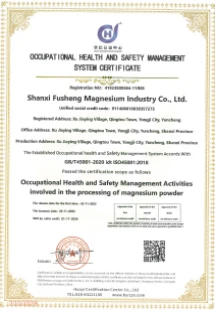
Passed ISO 9001:2015, ISO 14001:2015 Environmental Management Certificates, ISO 45001:2018 Occupational Health and Safety Certificates, and most importantly, as a rare named factory in China, obtained full authorization from the Chinese government for magnesium powder production activities.
Quality Standard Control
Our production team control and optimize the whole production process, guaranteeing the highest quality standards, in each production step.
Global Layout
As a technical-commercial oriented company, NY2 has grown to have now five offices located in China Mainland, lndia, Turkey, Hong Kong, German with either sales or warehouse function.
One-stop Solution
With rich experience and one-to-one service,we can help you choose products and answer technical questions.
-
![Magnesium for Additive Manufacturing]() Magnesium for Additive ManufacturingMagnesium, with the element symbol Mg, is a metal element that exhibits various desirable properties for additive manufacturing (AM). Its low density, high specific strength, and excellentread more
Magnesium for Additive ManufacturingMagnesium, with the element symbol Mg, is a metal element that exhibits various desirable properties for additive manufacturing (AM). Its low density, high specific strength, and excellentread more -
![Magnesium for Soil Conditioner]() Magnesium for Soil ConditionerMagnesium for Soil Conditioner: Magnesium powder is used as a soil conditioner to supplement magnesium levels in deficient soils. This helps in enhancing plant growth and overallcrop yield.read more
Magnesium for Soil ConditionerMagnesium for Soil Conditioner: Magnesium powder is used as a soil conditioner to supplement magnesium levels in deficient soils. This helps in enhancing plant growth and overallcrop yield.read more


What is Other Industries
Other Industries, with the element symbol Mg, is a metal element that exhibits various desirable properties for additive manufacturing (AM). Its low density, high specific strength, and excellent comprehensive mechanical properties, combined with good damping characteristics, hydrogen storage capacity, and biocompatibility, make it a promising material for various applications including aerospace, rail transportation, new energy, and biomedicine.
Lightweight
With a density of 1.7g/cm3, magnesium is the lightest structural metal available. Its alloys are therefore ideal for projects where weight is a key concern, giving a weight advantage over aluminium of 33%, and as much as 50% over titanium. In the automotive industry specifically, the move towards electric and energy efficient vehicles will only accelerate demands for component parts to be made ever-lighter.
Strong
Magnesium naturally provides good levels of stiffness due to its hexagonal, close-packed, crystal structure. Cast magnesium alloys have tensile strengths up to 280 MPa and yield up to 160 MPa, while wrought magnesium alloys are produced with tensile strengths up to 360 MPa and yield strengths up to 300 MPa.
Plentiful
Magnesium is the eighth-most abundant element on the planet, making it a cost effective and readily available choice. Magnesium alloys are the third-most popular non-ferrous casting material.
Resistant to unwanted mechanical vibrations
Magnesium has the highest known damping capacity of any structural metal, capable of withstanding 10x more than aluminium, titanium, or steel. It is also flexible, making it easy to machine and cast and meaning it can be injection moulded.
Application of Other Industries
Automotive applications
Today's interest in magnesium for automotive applications is based on the combination of high strength properties and low density. In automotive applications weight reduction will improve the performance of a vehicle by reducing the rolling resistance and energy is used in acceleration, thus reducing fuel consumption and, moreover, a reduction in the greenhouse gas CO2 can be achieved.
Aerospace applications
Cars, vans and trucks are not the only vehicles that have incorporated magnesium in their designs. The aerospace industry has a long history of using the metal in many applications both civil and military. It is critical to lower the weight of air and space craft, as well as projectiles, if we are to achieve decreases in emissions and greater fuel efficiency. These changes will result in lower operational costs as well.
Medical Applications
In the 1st half of last century, magnesium was first introduced in the medical industry as an orthopedic biomaterial. There are many characteristics and properties that make magnesium a very attractive option for use in implants and similar applications. Other common implant materials have densities that range from 3.1-9.2g/cm3, whereas the density of natural bone is 1.8-2.1g/cm3 (112.37-131.10lb/ft3). Magnesium alloys are much more comparable, at a density of 1.74-2.0g/cm3 (108.62-lb/ft3).
Electronic applications
In the current market, small and portable electronics are trending upward. The demand for compact devices that can be easily transported is booming and magnesium is often a key component in meeting this demand. Many magnesium alloys being used to replace plastics are just as light, but they are much stronger and more durable. Magnesium is also better in regards to heat transfer and dissipation as well as its ability to shield electromagnetic and radio frequency interference.
Production Process of Magnesium
Magnesium shavings, the general specification is 2*3*0.5mm, this is the initial product for the production of magnesium granules. Magnesium ingots are used to directly mill and break swarf, and then sieve and pack without going through the granulation process.It is mainly used for the production of Grignard reagent, which is a kind of metal organic halide, such as ethyl magnesium chloride, used in organic synthetic drugs, perfume and other fine chemical products; in addition, it can also be used as a desulfurizer in metallurgy. It can also be used as lighting agent, flash powder, etc.
Magnesium fine powder, there are two main production methods. One is sifted out from the magnesium powder processed by conventional milling chip breaking and granulation, the output is low and it needs to be accumulated for a long time; The other is It is atomized magnesium powder. This kind of fine powder has good ball forming rate, high production cost and expensive price. It is generally used in medicine and 3D printing. Magnesium fine powder is mainly used in signal flares, flares, blasting and camera flashes, and also as welding rods. Used in additives and refractories.
Magnesium alloy shavings. The main products are AZ91 magnesium alloy shavings, which are also processed by mechanical milling and chip breaking. The general size is similar to that of magnesium shavings. They are mainly used as raw materials for semi-solid injection molding of magnesium alloy parts.
Magnesium-aluminum alloy powder, the main processing method is to melt and alloy aluminum ingots (or waste materials containing aluminum) and magnesium ingots (or waste materials containing magnesium), cool and crush them, and grind them into fine powder by ball mill. The general specification from 30 mesh to 350 mesh. Generally, fireworks use 80-160 mesh specifications. It is mainly used as a luminescent agent in fireworks, as flares, signal flares, and incendiary bombs in military industry, and can also be used in refractory materials such as magnesia carbon bricks.
Steps if matl released/spill
Use respirator. Avoid dusting. Use non- sparking tools. Clean dry powder may be swept gently to avoid dusting and placed in clean drums and sealed. Wet or contaminated material should be placed in vented containers and moved to a remote area.
Precautions-handling/storing
Ground all handling and transferring operations. Store in dot approved containers. Avoid direct viewing of magnesium fires as eye injury may result.
Neutralizing agent
Not applicable
Waste disposal method
Notify your local environmental officer. Keep in
Covered containers pending disposal. Dispose of in accordance with federal, state and local regulations.
Other precautions
Periodic medical examinations are recommended for individuals regularly exposed to dust.
Handling and Storage of Magnesium Powder
Handling
Wash thoroughly after handling. Remove contaminated clothing and wash before reuse. Use with adequate ventilation. Ground and bond containers when transferring material. Use spark-proof tools and explosion proof equipment. Avoid contact with eyes, skin, and clothing. Empty containers retain product residue, (liquid and/or vapor), and can be dangerous. Avoid ingestion and inhalation. Store protected from air. Do not pressurize, cut, weld, braze, solder, drill, grind, or expose empty containers to heat, sparks or open flames.
Storage
Keep away from sources of ignition. Store in a tightly closed container. Store in a cool, dry, well-ventilated area away from incompatible substances. Water free area.
Handling and Storage of Magnesium Powder
Handling
Wash thoroughly after handling. Remove contaminated clothing and wash before reuse. Use with adequate ventilation. Ground and bond containers when transferring material. Use spark-proof tools and explosion proof equipment. Avoid contact with eyes, skin, and clothing. Empty containers retain product residue, (liquid and/or vapor), and can be dangerous. Avoid ingestion and inhalation. Store protected from air. Do not pressurize, cut, weld, braze, solder, drill, grind, or expose empty containers to heat, sparks or open flames.
Storage
Keep away from sources of ignition. Store in a tightly closed container. Store in a cool, dry, well-ventilated area away from incompatible substances. Water free area.

Packaging/Transportation of Magnesium Desulfurizer
Use bags, metal pail, or paper pail to pack, the underlayer are plastic bag.
Transport Tool: Trucks or containers.
Storage Methods: The storehouse should be ventilated, dry, fire preventing, wet preventing, static preventing and the hermetic goods can be stored for 6 months.
Our certifications


FAQ
As one of the leading Other Industries suppliers in China, we warmly welcome you to buy Other Industries for sale here from our factory. All our products are with high quality and competitive price. For specifications, contact us now.
manufacturing investment, production tools, industrial development